
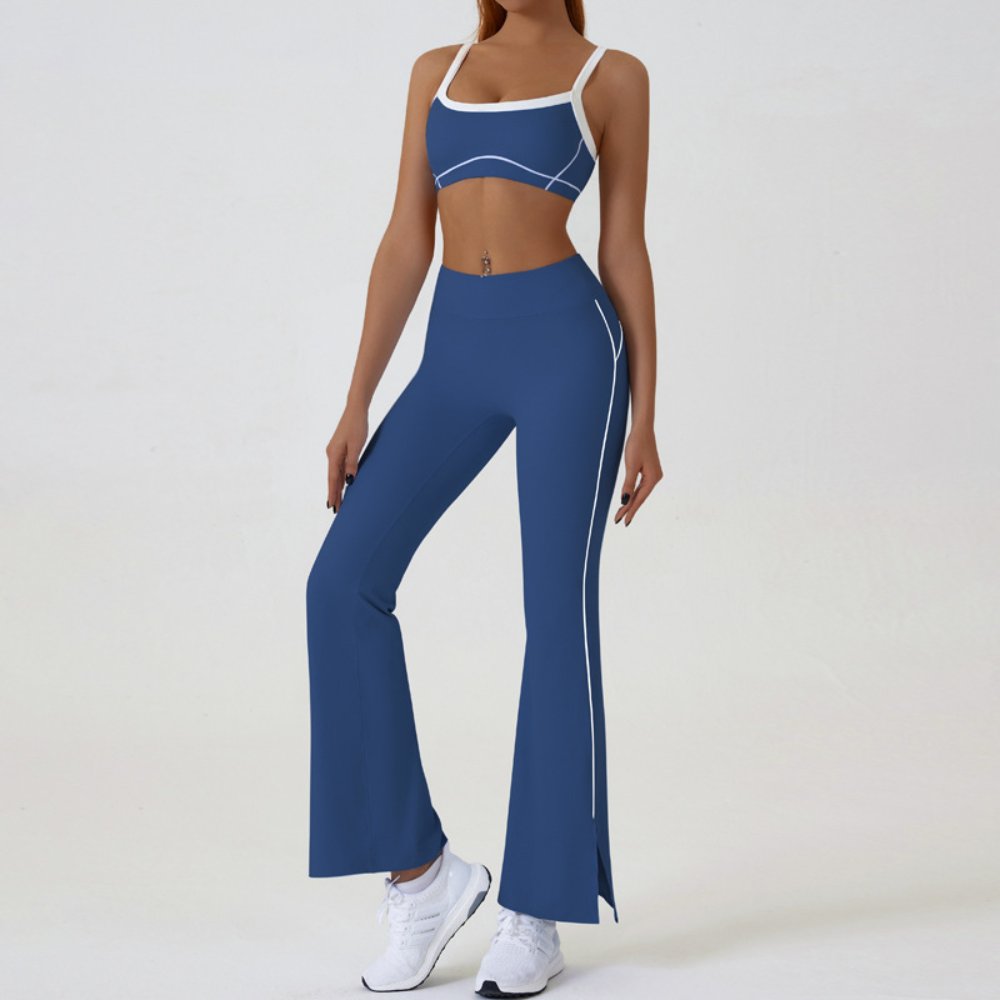
For a colour-block yoga set enquiry, ask the supplier to identify each relevant garment panel and link it to an agreed colour reference. Keep a screen photograph, a proposed colour name and an approved physical reference in separate fields. Confirm which top and bottom variant the quotation covers before approving the panel map. A catalogue image can identify a design, but it cannot guarantee the exact production colour or establish colourfastness.
A description such as blue with contrast trim may seem sufficient until several people interpret it differently. One person may be referring to the top’s main fabric, another to its edges and another to the pants. A panel reference map gives those conversations a shared location. It helps a buyer ask what belongs where without assuming that a photograph is a complete production instruction.
Choose the exact set reference first
The historical official product page used for this enquiry is Jinsheng’s High-Elastic Color-Block Yoga Set. Its description refers to a sports-bra component and a high-waisted flared or short-pant option. Treat that wording as a reason to clarify the quoted variant. It does not settle which bottom will be supplied for a particular order or establish the quantities in the quotation.
Product reference:
https://js-yogaclothes.com/product/high-elastic-color-block-yoga-set/
The selected catalogue image shows a blue contrast-trim top and flared pants together. It is a useful design reference, including where a contrasting area appears in that view. It does not prove the material used in each area, whether the appearance is created by separate panels or another method, or which colour reference the supplier will use. Ask for those details where they affect the order.
Separate garment identity from panel identity
Begin with the full product reference and the top and bottom variants proposed by the supplier. Then ask the supplier to mark the relevant areas on suitable views. Use simple identifiers such as top main area or neckline edge, provided both parties can locate them. If a part is not visible in the selected image, request another supplier reference rather than describing it as observed.
Keep front and back views clearly identified. An edge visible from the front may continue differently around the garment, while a colour shown on the top does not automatically define the pants. Ask whether the same reference is intended for each identified area. Do not force a shared answer simply because the catalogue presents the garments as a coordinated set.
The map should also show which construction questions remain open. A contrasting strip in a photograph might not explain how that appearance is made. Request the supplier’s description for the selected style instead of declaring a binding, inserted panel or printed area from appearance alone. The purchasing record should distinguish an identified visual area from a confirmed manufacturing detail.
Use a panel-to-colour reference table
Garment and area | Marked-view reference | Supplier colour reference | Buyer’s accepted reference | Confirmation needed
Top main area | Supplier to identify on the selected view | Supplier to provide | Buyer to record after approval | Confirm the exact variant
Top contrasting area | Supplier to mark the relevant boundary | Supplier to provide separately | Buyer to record separately | Clarify how the contrast is supplied
Bottom main area | Supplier to identify for the quoted bottom | Supplier to provide | Buyer to record after approval | Confirm flared or other proposed option
Any additional contrasting area | Add only if relevant and confirmed | Supplier to provide | Leave open until agreed | Do not infer an unseen area
These are enquiry fields, not a declaration that every listed area exists as a separate fabric component. Let the supplier amend the map to match the actual quoted garment. Keep any change to the set variant visible before comparing the colour references.
Distinguish colour evidence from a screen impression
Use the catalogue photograph to explain which design area is under discussion, not as a guarantee of exact colour. Lighting, capture and display conditions can affect the appearance seen by a buyer. If colour accuracy matters to the purchasing decision, ask which physical sample or other agreed reference will control the approval and how it will be identified in the order record.
Keep the reference identifier attached to the relevant panel. A name such as navy or light blue may describe a general impression but may not identify the supplier’s exact proposed option. Ask the supplier to explain any colour code it uses. Do not invent a standard colour number, assume that a photographed shade matches one, or describe a digital selection as an approved physical swatch.
Clarify matching without promising identical results
If a buyer wants selected areas to use the same colour reference, state that request explicitly and ask the supplier to confirm its scope. Top and bottom components can require separate confirmation even when they are presented together. A shared reference in the enquiry is an instruction to discuss, not proof that different materials will appear identical in every condition.
Keep visual colour approval separate from material performance. A swatch comparison does not establish resistance to fading, washing behaviour or another untested property. Likewise, a catalogue claim about colour retention should not become an independent assurance in the buyer’s specification. Record any additional evidence requirement separately rather than hiding it inside a general colour approval.
Close the map before passing it onward
Before accepting a quotation reference, check that the agreed garment variant, marked views and colour references describe the same proposal. Identify any area that still lacks a supplier answer. If a response changes the bottom option or the method used to create a contrasting area, review the affected part of the map instead of treating the earlier photograph as automatic approval.
Retain the supplier’s marked reference and the buyer’s decision together. This lets another colleague understand what was actually agreed without interpreting a short colour name from an email. It also gives the supplier a precise location to address when a later sample appears different. Preserve the earlier record and document the new question rather than silently replacing an accepted reference.
Frequently asked questions
Can the catalogue photograph be our exact colour standard?
Use it to identify the design being discussed. Ask the supplier which agreed reference should control colour approval for the actual order. Do not claim that a screen image guarantees the production shade or a match to an unverified standard.
Does a coordinated set use one colour reference everywhere?
Not necessarily. Ask which reference applies to each relevant area and garment. Record any request for matching explicitly, and obtain the supplier’s answer for the exact top and bottom proposal rather than assuming a shared specification.
Should we mark a contrasting edge as a separate fabric panel?
Only after the supplier confirms the construction. A photograph may show a contrast boundary without explaining how it is produced. Keep the visual callout and the supplier’s construction statement separate until that question is resolved.
Does colour approval prove colourfastness?
No. Identifying or visually accepting a colour reference does not establish an untested performance result. If the buyer needs further evidence, define that requirement separately and ask what information is available for the selected product.
Prepare the next supplier message
Send Jinsheng the exact product link, identify the proposed top and bottom and ask for marked views of the relevant contrasting areas. Request colour references for those areas and state which buyer decisions remain open. Keep physical references, catalogue images and performance questions clearly distinguished.
Contact:
https://js-yogaclothes.com/contact/
Blog:
https://js-yogaclothes.com/blog/