
Separate supplier-confirmed care information from buyer branding before approving yoga pants label artwork. Identify the exact garment, assign an owner to each text or artwork section, and keep the source and approval status beside it. Ask the supplier to confirm care and composition wording for the quoted variant. A garment photograph, an existing logo file or a catalogue description does not establish the instructions that should appear on a finished label.
Label projects often arrive as one artwork file even though its contents come from different people. A buyer may provide a brand name, while a supplier provides technical wording and another colleague prepares the layout. Without clear ownership, an attractive proof can conceal a sentence that nobody has approved. A simple responsibility sheet helps prevent that problem without inventing care instructions or making assumptions about the supplier’s printing service.
Identify the pants before discussing the label
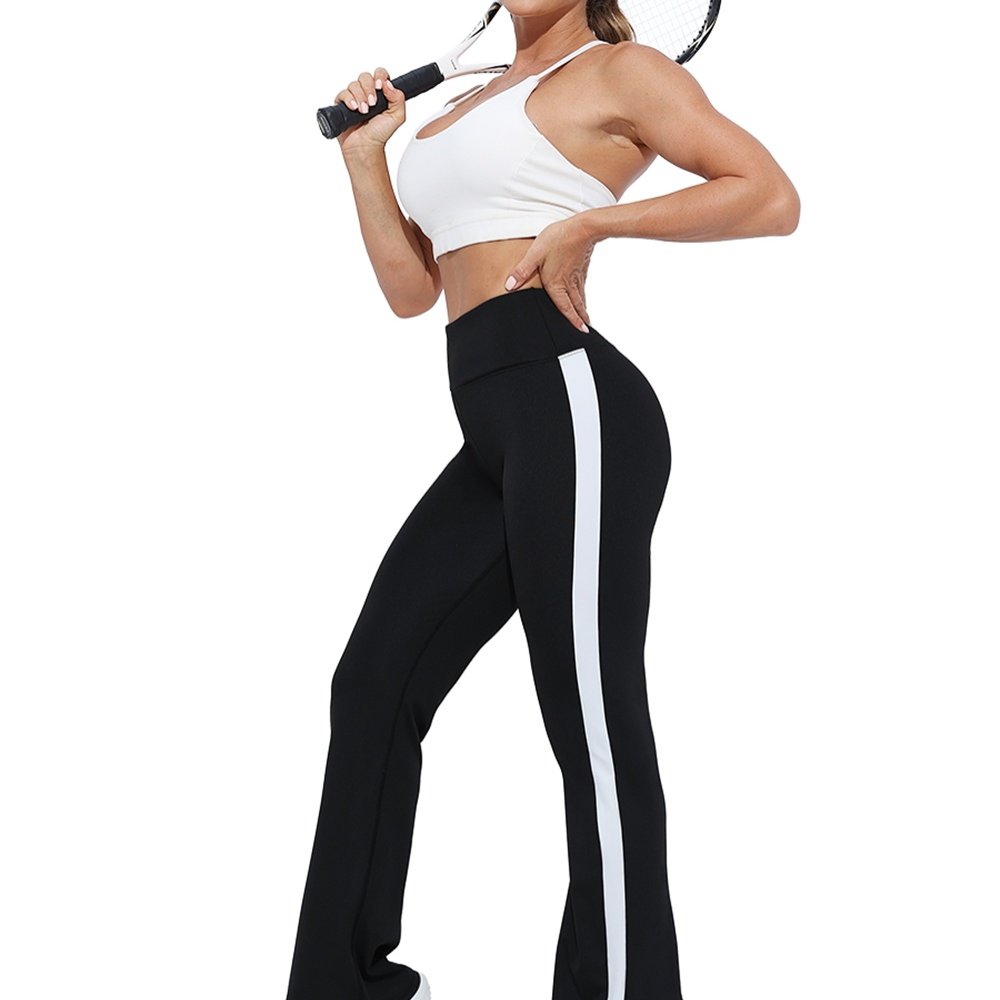
The historical Jinsheng product reference used here is Straight-Leg Yoga Pants #W918. Keep that full catalogue identity with the enquiry, and ask the supplier to confirm the exact variant being quoted. The selected photograph shows a black garment with contrasting side detail. It does not show an existing care label, confirm its wording or prove that label production is included in an order.
Product reference:
https://js-yogaclothes.com/product/straight-leg-yoga-pants-w918/
The cached product page contains inconsistent size entries and more than one dimension and weight block. Do not copy those entries into a garment specification or a label proof as though their meaning had been settled. Request the information needed for the selected order separately. A label approval task should not become an accidental approval of unrelated catalogue measurements.
Give technical text and branding different owners
Ask who will provide the care wording and the material statement for the quoted garment. Record the supplier’s named source or document reference, rather than assuming that a general product description is sufficient. If the supplier has not confirmed the text, mark it pending. Do not complete an empty area with washing advice taken from another style or from the buyer’s experience with a similar fabric.
In a separate section, identify buyer-controlled elements such as a brand name, logo file or preferred artwork layout. Confirm who has authority to approve them for this order. Providing branding assets does not mean the buyer has verified the technical wording supplied by somebody else. Likewise, a supplier’s confirmation of a material statement should not be treated as approval to use a buyer’s brand artwork.
Keep the responsibilities practical. One person may coordinate the final proof, but the record should still show who supplied and approved each part. This distinction is useful when a layout is correct but a care sentence remains unresolved. It lets the team ask a precise question instead of sending an ambiguous request to approve everything.
Use a responsibility sheet before the artwork proof
Content area | Information source | Proposed approval owner | Reference to retain | Open question
Care wording | Supplier-confirmed instructions for the selected variant | Named technical-text approver | Supplier statement or agreed document | Is the text confirmed for this garment?
Composition wording | Supplier-confirmed material statement | Named factual-content approver | Exact statement and scope | Which component or garment scope is covered?
Brand artwork | Buyer-provided asset | Buyer’s authorised artwork approver | Named artwork file and revision | Is this the approved asset for the order?
Layout and placement | Agreed label arrangement | Coordinating proof approver | Annotated proof and placement reference | Has the proposed arrangement been confirmed?
This sheet records a workflow, not a set of universal legal requirements. The information needed for a particular market or sales channel must be established through the buyer’s appropriate review process. Do not present a generic purchasing article or catalogue page as a substitute for that review.
Control wording changes before changing the layout
Ask the artwork preparer to keep approved technical wording intact while arranging it. A small editorial change can alter an instruction, a qualifier or the relationship between a heading and its text. If somebody proposes a wording change, return it to the person responsible for that content instead of treating it as a harmless design adjustment.
Keep language versions separate until their content owners have checked them. Record which version the supplier confirmed and which version is still a draft. A translated sentence should not inherit an approval merely because it occupies the same position in the artwork. If no approved translation is available, leave the item open rather than manufacturing one from an unrelated label.
Review the proof without inferring a supply service
When requesting a proof, ask what the supplier can actually provide for this order. Confirm whether label preparation, printing, attachment or another activity forms part of the quotation. These are scope questions, not capabilities established by the product photograph. The buyer’s artwork requirements should not be rewritten as a statement that a particular service is already included.
Use a marked garment reference to discuss proposed placement and orientation. Ask for confirmation that the proof belongs to the exact style and variant, then review the visible text and layout against the responsibility sheet. If a label sample is provided, record what was examined. Do not claim that a visual review proves wash durability, print permanence or any untested result.
Keep unresolved items visible at release
Before accepting the proof, distinguish factual text approval, branding approval and layout approval. If one remains pending, identify that section and the person who must respond. Avoid a single unchecked approval box that hides the difference. The aim is to give the supplier a usable decision record, not to create additional paperwork without a clear owner.
Keep the accepted proof, the supporting statements and the quotation scope together. A later receiving team should be able to identify which label content was agreed for the order without searching through informal messages. If the delivered label appears inconsistent, compare the exact text and reference first, then ask about the specific discrepancy instead of changing the retained approval record.
Frequently asked questions
Can we copy care wording from another yoga pants style?
Do not assume it applies. Ask the supplier to confirm instructions for the quoted garment and retain the source of that answer. Similar appearance, a shared category or a familiar fabric description does not settle the required wording.
Does a correct logo mean the whole label is approved?
No. Branding, technical wording and layout can have different approval owners. Record their decisions separately so approval of a visual asset does not silently validate factual content that has not been checked.
Should this process specify washing temperatures?
Only use information actually confirmed through the appropriate source for the selected product. This workflow supplies no care temperature, treatment method or durability claim. An unanswered instruction remains pending rather than being filled by guesswork.
Does a product photograph establish label placement?
Not when the relevant label is not visible. Request a specific placement reference and ask the supplier to confirm what is proposed and included. Keep that answer distinct from the catalogue’s garment styling image.
Send the supplier a clear approval request
Ask Jinsheng to identify the selected #W918 variant, provide the applicable technical wording and state the label-related supply scope. Attach buyer branding separately and identify the approver for each content area. Request a proof that makes open items visible before anything is treated as accepted.
Contact:
https://js-yogaclothes.com/contact/
Blog:
https://js-yogaclothes.com/blog/